
< Back to blog
June 4, 2026
Speed Cameras in Nairobi: Key Locations and Speed Limits to Know
Driving in Nairobi has become more controlled as speed cameras, monitoring cameras, and digital traffic enforcement continue to expand across major roads. For private drivers, chauffeur-driven clients, car hire users, and airport transfer passengers, understanding the main speed camera zones can help improve road safety, reduce fines, and make every trip smoother.
Nairobi traffic can change quickly. One minute you are cruising on an open bypass, and the next you are approaching a junction, interchange, toll point, school zone, or camera-controlled section. For visitors, self-drive clients, corporate drivers, and chauffeur teams, knowing the main speed camera zones around Nairobi helps you avoid unnecessary penalties, protect passengers, and drive more calmly.
This guide covers publicly reported speed camera zones and Nairobi speed-limit enforcement areas. It is not an official camera map. NTSA has not released a full public map of every speed camera location, and limits can change because of new signs, road works, traffic police directions, or temporary safety measures. Always follow the posted road signs.
It is especially useful if you are using a self-drive rental car, moving between JKIA and Westlands, taking Thika Road, using Lang'ata Road toward Karen or Nairobi National Park, driving toward Ngong Road or Jogoo Road, or connecting to the bypasses.
Kenya's Traffic Speed Limits Rules allow uniformed police officers to use speed camera records for traffic enforcement, and they list general maximum speeds for different vehicle classes. For private cars, the general limit is 110 km/h on dual carriageway highways and 100 km/h on single carriageway highways, while commercial vehicles, matatus, and PSVs are generally limited to 80 km/h.1
Important note: Camera positions, enforcement activity, and posted speed limits can change because of road works, traffic conditions, new signage, temporary enforcement, or updated road rules. Treat this as a practical driver-awareness guide, not an official government map. Always follow the current road signs, lane markings, police instructions, toll-road rules, and the conditions on the road.
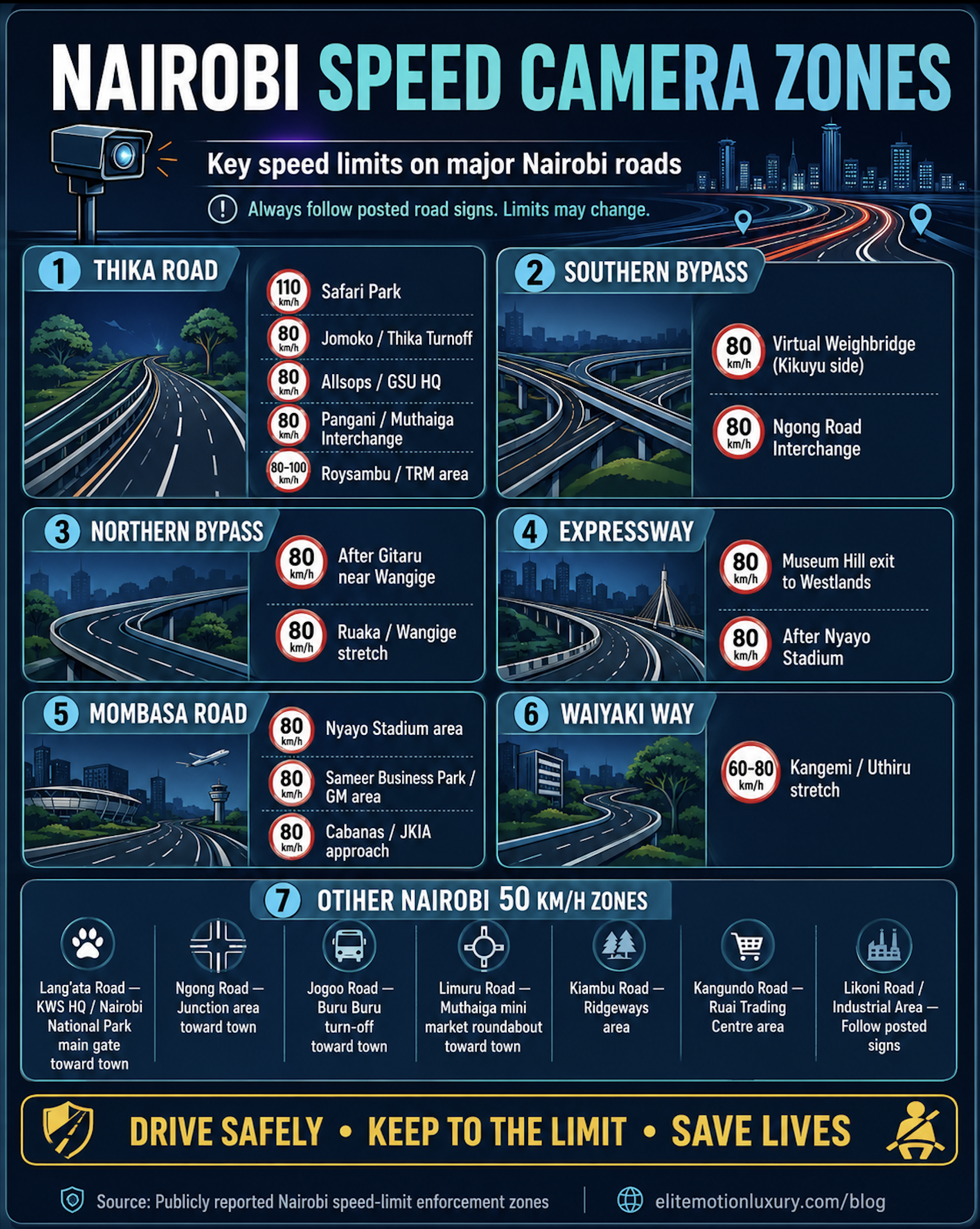
Infographic: publicly reported Nairobi speed camera zones and speed-limit enforcement areas. Always follow posted road signs because limits may change.
Why Nairobi Drivers Should Pay Attention to Speed Cameras
Speed cameras are not only about fines. They are usually placed around areas where speeding can cause serious accidents: interchanges, high-speed approaches, stadium zones, airport roads, built-up commercial areas, and roads with heavy merging traffic.
For EliteMotion Luxury Car Hire clients, this matters for three reasons:
- Safety: Nairobi roads often mix private cars, buses, motorcycles, pedestrians, trucks, and sudden lane changes.
- Cost control: Speeding fines, penalties, and delayed travel plans can make a simple trip more expensive.
- Vehicle protection: Smooth, compliant driving protects the car, passengers, and your rental deposit.
The safest approach is simple:
- Keep within the posted speed limit.
- Slow down early near interchanges, exits, toll points, and merging lanes.
- Leave enough distance from the car ahead.
- Avoid last-minute braking near camera zones.
- Plan extra time for airport transfers, meetings, events, and long-distance trips.
If you are not familiar with Nairobi roads, it is better to drive slightly under the limit than to assume an open road is safe for high speed.
Quick List: Commonly Reported Nairobi Speed Camera Zones
The locations below combine commonly reported speed camera zones with broader Nairobi speed-limit enforcement corridors. The recent NTSA-related speed-limit reports clearly cover Thika Road, Southern Bypass, Northern Bypass, Nairobi Expressway, Mombasa Road, and Waiyaki Way.2 NTV also reports that other monitored Nairobi corridors include Kiambu Road, Likoni Road / Industrial Area, and major accident-prone junctions.3 Always confirm with the actual road signs when driving.
| Road / Area | Reported zone | Reported limit |
|---|---|---|
| Thika Road | Safari Park area | 110 km/h |
| Thika Road | Jomoko / Thika Turnoff | 80 km/h |
| Thika Road | Allsops / GSU HQ | 80 km/h |
| Thika Road | Pangani / Muthaiga Interchange | 80 km/h |
| Thika Road | Roysambu / TRM area | 80-100 km/h |
| Southern Bypass | Virtual Weighbridge, Kikuyu / Ngong Road side | 80 km/h |
| Southern Bypass | Ngong Road Interchange | 80 km/h |
| Northern Bypass | After Gitaru near Wangige | 80 km/h |
| Northern Bypass | Ruaka / Wangige stretch | 80 km/h |
| Nairobi Expressway | Museum Hill exit to Westlands | 80 km/h |
| Nairobi Expressway | After Nyayo Stadium | 80 km/h |
| Mombasa Road | Nyayo Stadium area | 80 km/h |
| Mombasa Road | Sameer Business Park / GM area | 80 km/h |
| Mombasa Road | Cabanas / JKIA approach | 80 km/h |
| Waiyaki Way | Kangemi / Uthiru stretch | 60-80 km/h |
| Lang'ata Road | KWS Headquarters / Nairobi National Park main gate toward town | 50 km/h |
| Ngong Road | Junction area toward town | 50 km/h |
| Jogoo Road | Buru Buru turn-off toward town | 50 km/h |
| Limuru Road | Muthaiga mini market roundabout toward town | 50 km/h |
| Kiambu Road | Ridgeways area | 50 km/h |
| Kangundo Road | Ruai Trading Centre area | 50 km/h |
| Likoni Road / Industrial Area | Reported monitored corridor | Follow posted signs |
1. Thika Road Speed Camera Zones
Thika Road is one of the busiest high-capacity roads serving Nairobi, Kasarani, Roysambu, Ruaraka, Muthaiga, and the wider Kiambu/Thika corridor. It can feel like an expressway, but many sections are close to residential, commercial, and high-traffic access points.
Drivers should be especially careful around Safari Park, Jomoko, Allsops, GSU Headquarters, Pangani, Muthaiga Interchange, Roysambu, and TRM. Although some parts of Thika Road allow higher speeds, the limit drops in several busy sections. Interchanges, service-lane entries, and high-traffic zones require more caution.
Key Thika Road areas to watch:
- Safari Park area — often listed around 110 km/h, but drivers should still watch for posted signs and traffic flow.
- Jomoko / Thika Turnoff area — commonly reported around 80 km/h, especially near the junction section.
- Allsops / GSU Headquarters — commonly reported around 80 km/h.
- Pangani / Muthaiga Interchange — commonly reported around 80 km/h due to merging traffic and interchange movement.
- Roysambu / TRM area — commonly reported between 80 and 100 km/h depending on the section.
Driving tip: On Thika Road, do not rely only on the speed of other vehicles. Matatus and private cars may move fast, but enforcement zones can appear around junctions and interchanges.
2. Southern Bypass Speed Camera Zones
The Southern Bypass is popular for avoiding Nairobi CBD traffic and connecting routes toward Mombasa Road, Lang'ata, Ngong Road, Kikuyu, and the western side of the city. Because it has long open stretches, many drivers are tempted to accelerate.
Commonly reported camera or monitoring points include:
- Virtual weighbridge, Kikuyu side — commonly reported around 80 km/h.
- Ngong Road Interchange — commonly reported around 80 km/h.
This route is useful, but it also carries trucks, private cars, buses, and vehicles joining from different feeder roads. Speeds can feel comfortable until traffic suddenly compresses near an interchange.
Driving tip: Keep a steady speed early instead of braking suddenly when approaching the camera zone. Sudden braking can be risky for vehicles behind you, especially on busy bypass sections.
3. Northern Bypass Speed Camera Zones
The Northern Bypass connects areas around Ruaka, Two Rivers, Kiambu Road, Ruiru, Wangige, Gitaru, and the western/northern edges of Nairobi. It is useful for airport transfers, upcountry connections, and avoiding inner-city congestion.
Commonly reported zones include:
- After Gitaru, near Wangige — commonly reported around 80 km/h.
- Ruaka / Wangige stretch — commonly reported around 80 km/h.
This route has fast-moving traffic, but it also has junctions, curves, merging points, heavy vehicles, and sections with changing traffic flow. Drivers should keep a steady speed and avoid aggressive overtaking.
Driving tip: Be extra careful near junctions, shopping areas, and sections where pedestrians or local traffic may cross or join the road.
4. Nairobi Expressway Speed Camera Zones
The Nairobi Expressway is convenient for fast movement between JKIA, Mombasa Road, Westlands, and the city centre area. However, expressway driving requires discipline because vehicles move at higher average speeds and lane changes happen quickly.
The official Nairobi Expressway public safety notice says drivers should use the prescribed speed limit, with a maximum of 80 km/h shown by traffic signs, and also notes that monitoring cameras are installed throughout the Expressway.4 The Expressway FAQ also reminds motorists to follow the speed limits displayed at various sections of the road.5
Reported speed camera zones include:
- Museum Hill exit toward Westlands — commonly reported around 80 km/h.
- After Nyayo Stadium — commonly reported around 80 km/h.
Because the Expressway has elevated sections, toll points, exits, and merging lanes, drivers should avoid sudden lane changes and keep enough distance from other vehicles.
Driving tip: Plan your exit early. If you miss your planned exit, continue safely to the next exit instead of reversing, stopping, or making a sudden lane change.
5. Mombasa Road and JKIA Approach
Mombasa Road is one of Nairobi's most important routes, especially for airport transfers, hotel pickups, business trips, industrial-area movements, and travel toward Athi River, Machakos, or Mombasa. It is also one of the roads where visitors can easily misjudge speed because the road alternates between open stretches and congested urban sections.
Commonly reported speed camera zones include:
- Nyayo Stadium area — commonly reported around 80 km/h.
- Sameer Business Park / GM area — commonly reported around 80 km/h.
- Cabanas / JKIA approach — commonly reported around 80 km/h.
This road can shift quickly from open-flow traffic to heavy congestion, especially near the airport approach, industrial-area exits, and city entry points. Staying within the limit helps reduce sudden braking and unsafe lane changes.
Driving tip: If you are heading to JKIA, leave early instead of trying to make up time by speeding near Cabanas or the airport approach. Traffic can build up suddenly around airport, truck, and bus movements.
6. Waiyaki Way Speed Camera Zone
Waiyaki Way is a major route serving Westlands, Kangemi, Uthiru, Kinoo, Kikuyu, and Naivasha/Nakuru-bound traffic. It has fast sections, but also built-up areas where pedestrians, PSV stops, service lanes, and merging vehicles are common.
A commonly reported zone is:
- Kangemi / Uthiru stretch — commonly reported around 60-80 km/h depending on the exact section and posted signs.
Drivers heading toward Westlands, ABC Place, Kangemi, Uthiru, Kinoo, or Kikuyu should watch for posted signs and adjust speed early.
Driving tip: Reduce speed early around Kangemi and Uthiru. These sections can have sudden stops, pedestrians, buses pulling in and out, and vehicles joining from service roads.
7. Lang'ata Road and Other 50 km/h Nairobi Speed Zones
Some Nairobi roads have lower urban speed limits, especially as they approach the city centre, busy junctions, schools, hospitals, pedestrian areas, and public transport zones. These areas may not always have a publicly confirmed fixed speed camera, but drivers should treat them as high-enforcement zones.
NTSA has not publicly released a complete map of every camera location in Nairobi. Reported monitoring areas include major corridors, accident-prone areas, and junctions, while urban areas generally carry a 50 km/h limit.3
| Road / Area | Reported speed-limit zone | Reported limit |
|---|---|---|
| Lang'ata Road | From KWS Headquarters / Nairobi National Park main gate toward town/back | 50 km/h |
| Ngong Road | From Junction area toward town and back | 50 km/h |
| Jogoo Road | From Buru Buru turn-off toward town and back | 50 km/h |
| Limuru Road | From Muthaiga mini market roundabout toward town and back | 50 km/h |
| Kiambu Road | From around Ridgeways | 50 km/h |
| Kangundo Road | Around Ruai Trading Centre | 50 km/h |
| Likoni Road / Industrial Area | Reported as a monitored corridor | Follow posted signs |
| City-side Mombasa Road | From around Cabanas / GM toward town | 50-80 km/h depending on section |
| City-side Thika Road | From around Utalii / Pangani toward town | 50-80 km/h depending on section |
Older Nairobi speed-limit guidance lists Lang'ata Road, Ngong Road, Jogoo Road, Mombasa Road, Limuru Road, Thika Road, Kiambu Road, and Kangundo Road among roads with 50 km/h urban enforcement sections.6 Because this guidance is older, drivers should still rely on current road signs first.
Driving tip: Treat these city-side corridors differently from open bypass sections. Expect pedestrians, matatus, estate exits, school traffic, hospital access, police checks, and sudden lane changes. A safe speed may be lower than the posted maximum when traffic is heavy.
Safe Driving Tips for Nairobi Car Hire Clients
Whether you are using a self-drive vehicle, chauffeur-driven SUV, airport transfer, or executive car hire service, road safety should always come first.
Before the trip
- Confirm your route before leaving.
- Allow extra travel time during peak hours.
- Check whether your route includes the Expressway, Thika Road, Mombasa Road, Lang'ata Road, Ngong Road, Jogoo Road, Waiyaki Way, or the bypasses.
- Ask your driver to follow posted limits and avoid risky shortcuts.
- If you are self-driving, familiarise yourself with the vehicle before joining a high-speed road.
During the trip
- Wear your seat belt.
- Avoid distracting the driver.
- Keep luggage safely stored.
- Do not pressure the driver to overspeed.
- Respect speed limits around interchanges, toll points, junctions, and exits.
For self-drive clients
- Read the speed signs carefully.
- Avoid relying only on map apps for speed limits.
- Slow down near camera zones, schools, junctions, and construction areas.
- Remember that enforcement may use both fixed and mobile cameras.
- If you are unsure of the limit, reduce speed and follow posted signs.
Practical Tips to Avoid Speeding Fines in Nairobi
1. Watch the signs, not only the road design
Some roads look open and fast, but the legal limit may still be lower because of junctions, pedestrian risk, construction, or nearby settlements. If a sign says 80 km/h, treat it as the limit even if the road feels clear.
2. Use cruise control carefully
Cruise control can help maintain a steady speed on open roads, but do not use it blindly in Nairobi traffic. Turn it off where there is congestion, rain, construction, pedestrians, or frequent lane changes.
3. Slow down before interchanges
Many camera zones are near exits, entries, flyovers, and interchanges. These are places where vehicles merge, brake, and change lanes. Reduce speed before the interchange rather than braking at the last second.
4. Do not follow speeding drivers
A common mistake is assuming that if everyone else is moving fast, the speed is acceptable. Nairobi roads often have drivers who know the road but still take risks. Drive based on the signs and your own safety margin.
5. Allow extra time for airport and corporate trips
Most speeding happens when a driver is late. If you have a flight, board meeting, hotel pickup, wedding convoy, or client appointment, build in a buffer. It is cheaper and safer to leave 20 minutes earlier than to rush.
Self-Drive vs Chauffeur: Which Is Better for Nairobi Roads?
If you are confident with Nairobi traffic, a self-drive rental gives you flexibility and privacy. It works well for clients who know the routes, prefer independent movement, and can manage local driving pressure.
If you are visiting Nairobi for the first time, carrying VIP guests, attending business meetings, or moving between multiple locations, a chauffeur service may be better. A professional driver understands traffic patterns, enforcement zones, parking, airport timing, and route changes.
EliteMotion Luxury Car Hire offers both options, so you can choose based on your comfort level, schedule, and route.
Suggested Vehicle Choices for Nairobi and Bypass Driving
For Nairobi roads, comfort and control matter as much as power. A premium SUV gives you good visibility, ground clearance, and passenger comfort, especially when moving through mixed traffic or uneven service roads.
Good options include:
- Toyota Land Cruiser Prado — ideal for self-drive, business trips, family travel, and upcountry extensions.
- Land Cruiser V8 / LC200 — excellent for long-distance comfort, VIP use, and rougher routes.
- Mercedes-Benz V-Class — suitable for executive groups, airport transfers, family movements, and chauffeured trips.
- Range Rover / luxury SUV options — best for premium events, corporate impressions, and VIP transport.
Final Word
Speed cameras and speed-limit enforcement corridors around Nairobi are becoming more common on major roads such as Thika Road, Southern Bypass, Northern Bypass, Nairobi Expressway, Mombasa Road, Lang'ata Road, Ngong Road, Jogoo Road, Limuru Road, Kiambu Road, Kangundo Road, and Waiyaki Way. The safest way to avoid penalties is also the safest way to drive: follow the posted speed limit, keep distance, stay alert, and plan your journey early.
At EliteMotion Luxury Car Hire, safe and comfortable travel matters. Whether you are heading to the airport, a business meeting, a hotel, an event, or an upcountry trip, choosing the right vehicle and allowing enough travel time can make your journey smoother and safer.
If you are hiring a car in Nairobi and want help choosing the right vehicle for your route, EliteMotion Luxury Car Hire can advise you on self-drive and chauffeur options for JKIA transfers, Westlands meetings, Thika Road trips, bypass routes, weddings, safaris, and corporate transport.
Drive safely, comply with the limits, and enjoy Nairobi with confidence.
FAQ: Nairobi Speed Cameras
Are these Nairobi speed camera locations official?
No. This guide combines publicly reported speed camera zones with broader Nairobi speed-limit enforcement areas. NTSA has not released a full public map of every speed camera location, and camera enforcement can change, so always rely on current road signs and official instructions.
What speed should I drive on Nairobi bypasses?
Many reported bypass camera zones are around 80 km/h, but the correct limit is the one posted on the road at that section. Conditions such as rain, traffic, construction, and merging vehicles may require a lower speed.
Is the Nairobi Expressway speed limit 80 km/h?
The Nairobi Expressway public safety notice says drivers should drive at the prescribed speed limit, with a maximum of 80 km/h shown by traffic signs.4 Always follow the signs displayed on the exact section you are using.
Can I use a self-drive rental on these roads?
Yes, if you have a valid driving licence and are comfortable with Nairobi traffic. If you are unfamiliar with the city, travelling with VIPs, or handling time-sensitive airport or corporate movements, a chauffeur may be more convenient.
What is the safest way to avoid speeding fines in Nairobi?
Plan your trip early, watch posted signs, avoid following speeding vehicles, and reduce speed before camera-prone zones such as interchanges, airport approaches, toll points, and bypass junctions.
Suggested Featured Image Alt Text
Speed camera and speed-limit enforcement zones in Nairobi showing Thika Road, Southern Bypass, Northern Bypass, Nairobi Expressway, Mombasa Road, Lang'ata Road, Ngong Road, Jogoo Road, and Waiyaki Way.
Publishing Note
Before publishing, confirm the latest limits with current roadside signage, NTSA updates, or traffic police guidance. Do not rely only on social media graphics, because camera locations and speed limits can change. For 50 km/h urban corridors, present them as speed-limit enforcement zones unless there is a current official source confirming a fixed camera.
Related reading
- The Process of Traffic Fines in Kenya: From Offense to Resolution
- Your Rights During a Police Traffic Stop in Kenya
- Number Plate Offences in Kenya: Rules, Penalties and Checks Before You Drive
Planning a rental? Browse our fleet of cars for hire to compare vehicle options for your trip.
Footnotes
-
https://new.kenyalaw.org/akn/ke/act/ln/1975/62/eng@2022-12-31 ↩
-
https://eastleighvoice.co.ke/infographics/311186/ntsas-speed-limits-on-city-highways ↩
-
https://ntvkenya.co.ke/news/speed-cameras-how-ntsas-automated-system-works/ ↩ ↩2
-
https://nairobiexpressway.ke/downloads/Nairobi_Expressway_Public_Safety_Notice.pdf ↩ ↩2
-
https://sokodirectory.com/2019/10/list-of-points-with-new-speed-limits-in-nairobi-roads/ ↩